The number of Australian children considered at risk of poorer health, education and life outcomes due to employment stress in the family has likely doubled to 1.4 million children this quarter, according to modelling published in a new report by the Mitchell Institute at Victoria University.
The COVID-19, Employment stress and student vulnerability in Australia report (PDF, 1.46 MB) estimates an extra three quarters of a million children are now living in families experiencing employment stress.
Report author Kate Noble said governments at all levels needed to act swiftly to prevent children having their long-term educational, health and life outcomes damaged by the economic impact of COVID-19 related job loss.
“There is a strong correlation between children’s learning and development outcomes, and parental employment status,” she said.
“Children in families experiencing job loss are around 15% more likely to repeat a grade at school. Adolescents are particularly vulnerable and more likely to leave school early and less likely to attend university if they have an unemployed parent.”
The report maps out which regions and socio-economic groups across the country have been most affected by job losses or inability to work, as a result of COVID-19 restrictions.
In most regions, the number of children affected by employment stress in the family has doubled, while some of the worst affected regions having experienced three-fold increases.
Regional communities that rely on the most affected industries, such as tourism, and disadvantaged communities in outer suburban areas are among those hardest hit.
However, many families previously considered financially secure are now under employment stress due to parental job loss, salary cuts and reduction of work hours.
“Our schools, preschools and teachers have done a remarkable job responding to COVID-19; but the reality is, they’re not equipped to effectively respond to skyrocketing levels of student vulnerability,” she said.
The report recommends a range of urgent measures and longer term reforms designed to support students, reduce inequality, and improve the stability of the early childhood education sector, including:
- Ensuring that families experiencing financial hardship can access preschool and other early learning programs at low or no cost, increasing government support where needed.
- Increasing provision of social, health and economic supports in and through schools and ECEC providers; for example, breakfast clubs and partnerships with external services.
- Increasing student counselling and support for students, particularly during the final years of secondary education.
- Funding schools to meet increased levels of vulnerability, as needs-based funding arrangements will not accurately capture a rapid unemployment shock.
Background
The modelling is based on ABS data and job loss modelling by the Grattan Institute.
Table 1: Regions with the largest increases of children experiencing family employment stress
| Area (SA3) | 2016 | 2020 estimate | Percentage increase |
| Nillumbik – Kinglake (Melbourne) | 759 | 3,800 | 401 |
| Sutherland – Menai – Heathcote (Sydney) | 1,251 | 6,000 | 380 |
| Rouse Hill – McGraths Hill (Sydney) | 494 | 2,300 | 365 |
| Pittwater (Sydney) | 710 | 3,300 | 365 |
| Cronulla – Miranda – Caringbah (Sydney) | 1,190 | 5,400 | 354 |
| Hawkesbury (Sydney) | 314 | 1,400 | 346 |
| Warringah (Sydney) | 1,925 | 8,400 | 336 |
| Brisbane Inner – West | 555 | 2,400 | 332 |
| Molonglo (ACT) | 40 | 170 | 325 |
| Hobart Inner | 496 | 2,100 | 323 |
Table 2: Regional areas with greatest increases in children experiencing family employment stress
| Area (SA3) | 2016 | 2020 estimate | Percentage increase |
| Queanbeyan (NSW) | 725 | 2,800 | 286 |
| Barwon – West (Geelong) | 320 | 1,200 | 275 |
| Biloela (QLD) | 169 | 600 | 255 |
| Surf Coast – Bellarine Peninsula (Geelong) | 1,154 | 4,100 | 255 |
| Southern Highlands (NSW) | 767 | 2,600 | 239 |
| Esperance (WA) | 245 | 800 | 227 |
| Snowy Mountains (NSW) | 276 | 900 | 226 |
| Gold Coast Hinterland (QLD) | 307 | 1,000 | 226 |
| Warrnambool (VIC) | 884 | 2,800 | 217 |
| Broadbeach – Burleigh (QLD) | 887 | 2,700 | 204 |
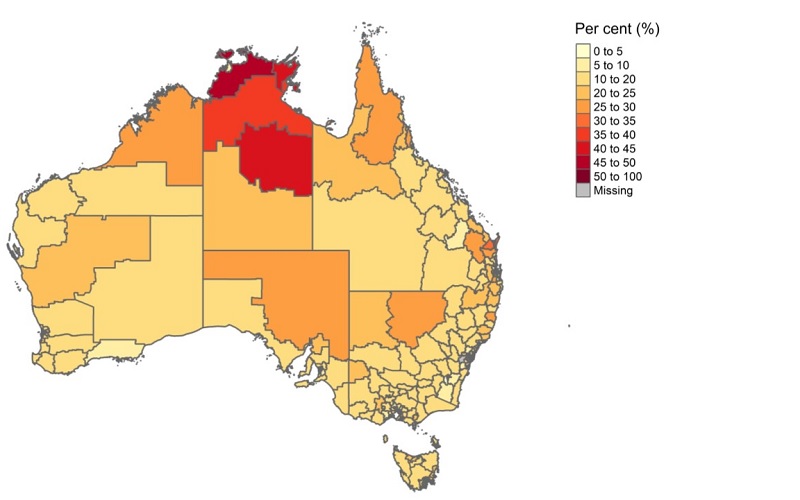
Figure 1: Percentage of school- and pre-school children with employment stress in the family
2016
2020 estimate
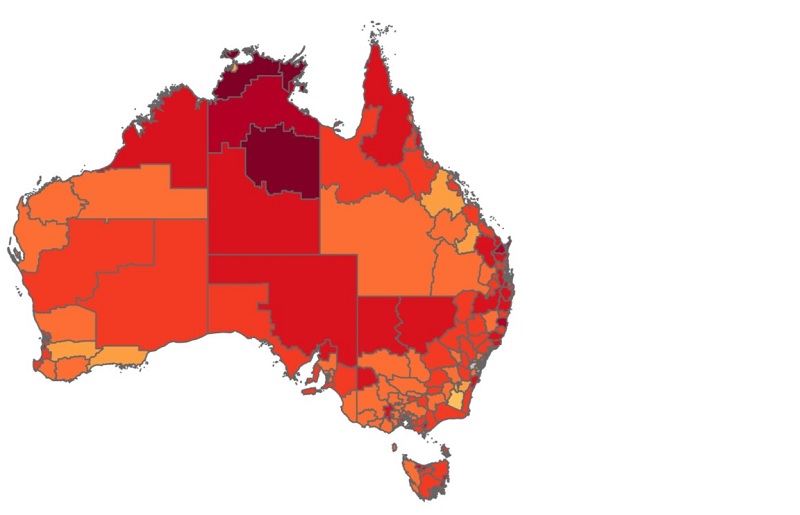
Source: Mitchell Institute analysis of ABS Census 2016 and Grattan Institute modelling of COVID-19 employment shock
Map text alternative
The first map shows the proportion of preschool and school children in families affected by employment stress in 2016 across different parts of Australia. It shows that in 2016 in most regions between 5% and 25% of children were in families affected by employment stress, except in the north of the Northern Territory where the proportion of children in families experiencing employment stress was between 35% and 45%. The second map shows the Mitchell Institute’s estimates of the proportion of children in families affected by employment stress in 2020 following COVID-19. It shows that in 2020 there have been large increases of employment stress right across Australia, with at least 30% of children living in families with employment stress in almost all areas and even higher concentrations in many regions, including the northern parts of the Northern Territory.